24.04.2026
5 min.

The heart of milk foam

Which milk is really suitable for latte art motifs

Latte art doesn't start with the espresso, but with the milk foam. Texture, temperature and the interaction of milk, coffee and water are crucial throughout the entire process - from the cold start to the finished caffè latte.

Whether the result is a heart, tulip or rosetta depends directly on how the milk foam develops: fine-pored, shiny and stable enough to combine cleanly with the espresso crema.

Milk, coffee and water: the basis for perfect milk foam

Several factors come together to produce good milk foam:

  • Milk (cow's milk or milk alternative)
  • Espresso as the basis for caffè latte
  • Water for extraction in the coffee
  • Temperature and technology

Particularly important: the choice of milk or plant-based drink strongly influences the taste, structure and stability.

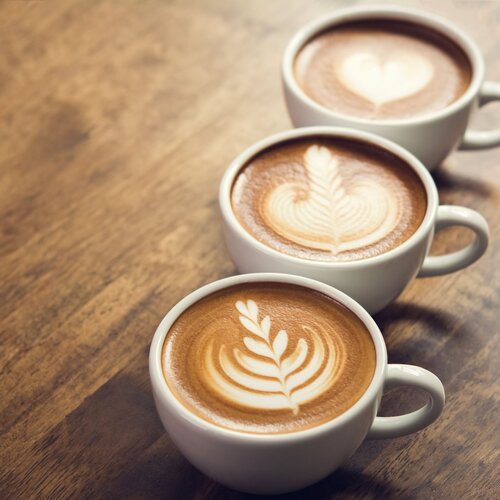
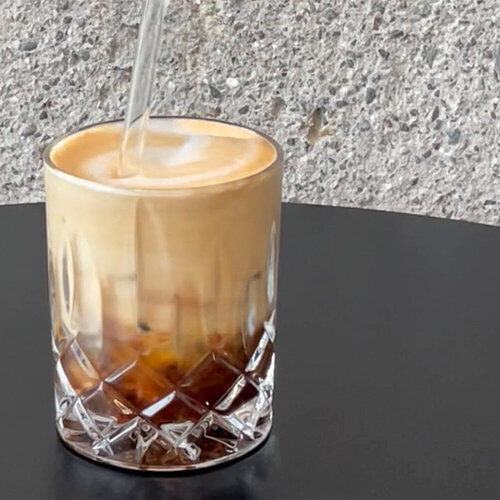
Coffee latte art in a cup
Barista frothing milk on Black&White4 CTS

Cow's milk as a classic for latte art

Cow's milk remains the classic choice for latte art.

Full-fat cow's milk (approx. 3.5 % fat) is particularly suitable because it:

  • forms a very stable milk foam
  • provides a silky-smooth texture
  • can be poured in a controlled manner
  • creates a clear contrast on espresso

UHT milk can also be used, but heating it changes the texture slightly.

Semi-skimmed milk also works, but is less forgiving and requires more control when whisking.

Milk alternatives - new textures, new rules

Vegan milk alternatives and plant-based milk alternatives are now an integral part of modern coffee culture and a conscious vegan diet.

Depending on the variety, they are suitable for latte art to varying degrees.

Oat milk (oat drink)
Oat milk is the most popular milk alternative for latte art.

It has:

  • creamy, stable milk foam
  • mild taste
  • good workability in espresso
  • a soft, flowing texture

Barista oat milk or barista versions are particularly optimized for frothing and are ideal for latte art motifs.

Oats contain natural carbohydrates that make the drink slightly sweet and harmonize well with coffee.

Coffee machine on wooden table with milk alternatives such as oat milk, almond milk, soy milk
Plant milk

Is plant-based milk the better choice?

Plant-based alternatives are often discussed as a better choice, especially in the context of health and sustainability.

Possible advantages:

  • fewer animal products
  • often organic products available
  • partly enriched with vitamin B12 and vitamin B2
  • Suitable for vegan diets
  • Potentially positive effects on cardiovascular disease

However, cow's milk naturally provides nutrients and remains a high-quality food.

The decision depends on taste, ethics and diet.

The 3 phases for perfect milk foam

Regardless of whether cow's milk or a plant-based milk alternative is used, the technique remains crucial.

1. aeration
Cold milk product (approx. 4 °C) is mixed with air.

Target:
- Fine microbubbles
- Volume build-up without over-molding

2. rolling
The milk is set in motion in the vat.

Aim:
- smooth, shiny texture
- Homogeneous milk foam without visible bubbles

3. stop the temperature

Optimal:
- Cow's milk: 55-65 °C
-Oat drink and other plant-based drinks: 50-60 °C

Too high a temperature leads to dry foam, too low to an unstable structure.

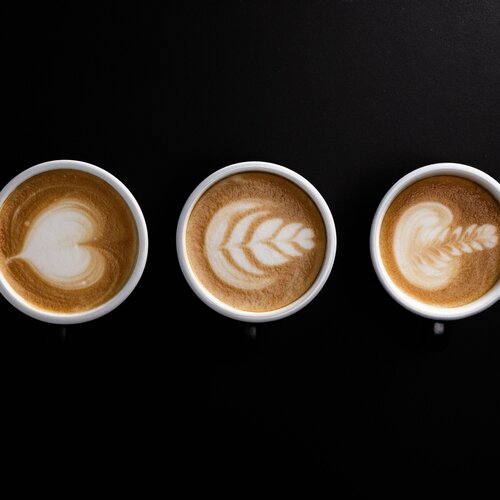
Barista makes latte art in cup on black table
Hand grips coffee cup with latte art on black background

Latte art motifs step by step

Heart

  1. Pour the espresso into the cup (crema as a base)
  2. Pour in the milk from a medium height so that it falls under the crema
  3. Move closer to the surface
  4. Fill in a circle
  5. Finally, pull through the center

Result: classic heart, ideal for caffè latte.

Rosetta (leaf motif)

  1. Tilt the cup slightly
  2. Pour the milk slowly and close to the surface
  3. Move sideways slightly back and forth
  4. Build up the pattern towards the top
  5. Finish off with a final draught

Result: fern-like, filigree latte art motif.

Tulip

  1. Pour the first small amount of milk into the cup
  2. Pause, then build up further layers
  3. Stagger each layer slightly
  4. Finally, draw through all layers

Result: stacked tulip with clear shapes.

Francesca's Tip:

Coffee Trainer

"A perfect milk foam is the prerequisite for good and beautiful latte art. If the texture is too coarse or too liquid, it becomes almost impossible. That's why it's important to first learn how to froth milk perfectly before attempting latte art. With our BW4 CTS, the barista has the perfect support. Perfect milk foam can be created at the touch of a button and the barista can start pouring straight away. Would you also like to learn the basics of milk frothing and the first steps in latte art? Then sign up for a course at the Thermoplan Coffee Academy!"

Conclusion

Whether cow's milk, oat milk or other plant-based milk alternatives, the decisive factor for latte art is always the milk foam.
Today, barista oat milk and high-quality plant-based alternatives produce results that are almost comparable to animal milk.
If you really want to master latte art, you don't need perfect milk, but an understanding of technology, temperature and the interplay between espresso, coffee, drink and milk foam. Because latte art is more than just a pattern. It is a moment of calm, technique and taste.

You might also like

CreanetBüroplanung ZürichObstbrände SempacherseeBüroplanung LuzernBüroeinrichtung ZürichGunzwiler DestillatePlafondnova - Deckensysteme WandsystemeWaldis MarkenmöbelPhotovoltaikanlage, SolartechnikWaldis Berry BüroplanungAntriebslösungen, Antriebstechnik, motion ControlAG kaufen, AG verkaufen und AG gründenMauchle PoolFull Service Marketing Agentur AG Mantel kaufenAG Mantel verkaufenTRennwandsystem